African-Americans Tracing Ancestral Roots Through DNA
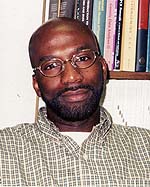
Photo: courtesy of Prof. Rick Kittles.
Photo caption: Prof. Rick Kittles, a Howard University geneticist working on DNA tests that will allow African Americans to trace their heritage.
About the Author
Sources: The Times (London), The Gazette (Montreal), The Boston Globe
As science races forward, it is allowing African Americans to take a step into the past. Howard University plans to offer a DNA test that will allow blacks to finally find out for certain where their African ancestors came from. Using a blood sample, the test will compare an individual's genetic makeup against samples taken from various African populations.
Several hundred people were tested as the database was being prepared. Although the actual procedure has been perfected, the test is not yet available to the public. "We're still dealing with the logistics," said Howard University geneticist Rick Kittles, who spearheaded the project. "It won't be available to the public before 2001." Once available, the test could cost around $300. The university will offer two versions of the test, one tracing mitochondrial DNA passed from mother to child and the other examining the Y chromosome, which is passed from father to son.
Results will be compared with more than 2,000 samples from 40 separate African populations. In addition, the university has European, Native American, and Asian sample databases to trace genes which do not come from Africa.
Prof. Kittles's involvement in the project began as a personal interest. "I was interested in determining my ancestry," he said. "I discovered that my maternal lineage goes to Nigeria -- to the Yoruba -- and my paternal lineage goes to Germany." Kittles said that roughly 30 percent of African Americans are partially descended from whites, and he was not surprised to discover his familial ties to Europe. "Family lore had already suggested that, the test just confirmed it, so it wasn't jarring for me," he said. "But it might be for some African Americans."
Kittles said that one black man who participated in the project arrived to take the DNA tests wearing African robes and speculating that his forebears came from Mali. Instead, the tests revealed that his father's genes in fact came from Germany.
"I'm sure this will cause many people, not only African Americans, to question their conceptions of race and identity," Kittles said. "I mean, phenotypically I'm very dark-skinned so one wouldn't necessarily expect part of my relatives to have come from Germany. It contributes to the deconstruction of race because it shows that we as a population come from many different sources."
However surprising some of the results of the tests may be, Kittles believes that being able to trace one's heritage to specific areas will have far-reaching significance for African Americans.
"To a lot of blacks, knowing a little bit of the story is important. This will definitely contribute a lot to understanding the history of African Americans," Kittles said. "Most African Americans claim descent from all of Africa because we just have a general sense of origin, we don't know where we're really from." As Kittles himself learned, the new DNA testing will now enable many blacks to identify the particular ethnic group to which their African ancestors belonged.
"It would be very difficult to locate any actual relatives, but it does give me a sense of connection to the Yoruba," Kittles said of the revelation of his forebears' tribal identity. "I will definitely research the culture."
Scholars expect the test to be in high demand. "It doesn't mean anything to know that some of my people came from Africa," said Richard Newman of Harvard University's Du Bois Institute for Afro-American Research. "But if I can pinpoint a culture, a religion and language, then it can strengthen my sense of identity and relationship with Africa."
"I would call it a Godsend," said Charles Blockson of Temple University, an expert on African American genealogy. "DNA has now provided not only people of African descent an opportunity to trace their families, but people of other races and nationalitities as well."
Since slavery days blacks in America have struggled to retain ties to the communities of their origin in Africa. The 27,000 voyages of the brutal Middle Passage from the 1500s to 1867 brought an estimated 12 million African men, women and children to the New World. Captives were often separated from others of their ethnic background and thrown in with a diverse group of people with whom they could not communicate. When they arrived in the Americas, slaves were dispersed. In many cases they had no chance to speak their native language or practice their family and community traditions. In order to survive they had to learn the language of their masters and adapt to a new culture.
Most blacks came to the United States from the west coast of Africa, areas that are now Nigeria, Benin, Togo, Ghana and Sierra Leone. Smaller numbers arrived from Senegal, the Gambia, the Congo River basin and Angola.
"Despite the curious institution of slavery, which caused numerous problems [in African American genealogy], I found that most people of African descent can trace their family back to a certain level," said Blockson. But other obstacles often intervene, he said, including "miscegenation, native American ancestry, those of us who have Cape Verdean ancestors," and other elements. And then, he said, there is "the scar of shame - passing."
According to Blockson, families split by passing may find the DNA tests a mixed blessing. "For some families it will be agony - they're going to be exposed. But for others, ecstasy." Other benefits may flow from the testing as well, he argued, including added ammunition in the fight for reparations for slavery.
African American interest in Africa has been a constant throughout the history of black America, finding different expressions at different times, from the back-to-Africa movements of the 19th century to the Afrocentric scholarship that was born in the 1960s. But these public gestures of connection to the African homeland rested uneasily with the frustrations many African Americans faced in trying to trace their own more personal African history.
Alex Haley's book and television miniseries Roots, which told his own family's saga beginning with an African ancestor, Kunta Kinte, helped spark tremendous interest in African American genealogy. "I'm proud of my African ancestry," said Blockson, whose book, Black Genealogy, was published the same year as Roots. "I can trace it back to Nigeria. I'm rare in a sense, most people cannot do that." Calling the new DNA testing technology "a fantastic scientific phenomenon," Blockson said he hopes all families - black, white, Latino, mixed - learn to appreciate their unique histories.
"You look at the mixed race kids, all those beautiful colors, you have to hope the new generation will be able to eliminate the problem of race. But I would hope that they still hold onto their African heritage.