Translate this page:
You can translate the content of this page by selecting a language in the select box.
Share this link!

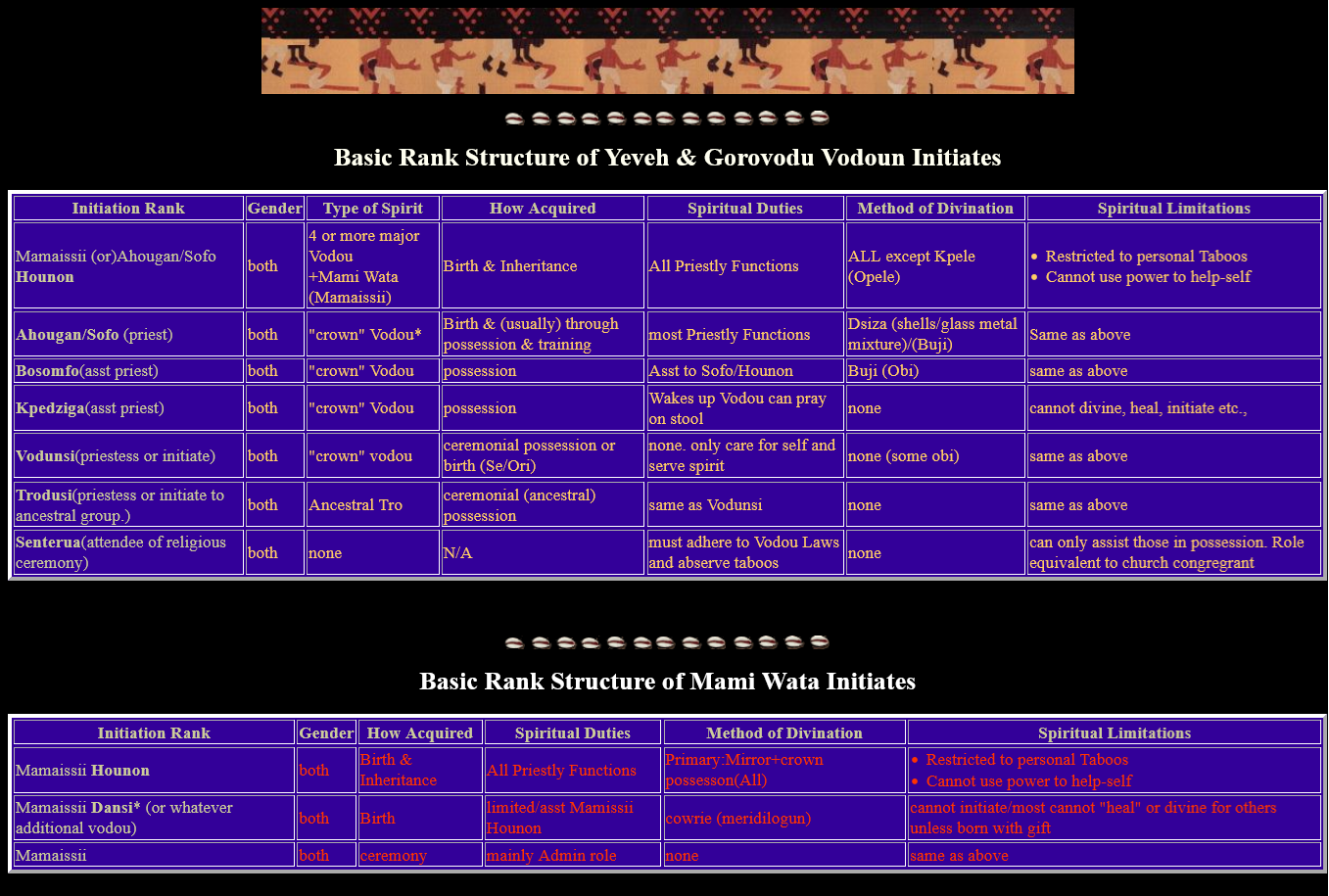
Woezoloo! Aenouledoo. This article briefly showcases the basic rank structure of West African Vodoun Initiates. Click on the photo to zoom in. Stay tuned for updates!
You are correct. There are some who identify themselves as “chief”. We can only reply how this title is used in West African Vodoun. Often, women who use this title, it generally refers to a title of honor i.e., meaning that she is either married to a male chief or that she has been bestowed this title in an honorary manner.
If she is married to a Hounon priest, she must be able to tell you what Vodou spirit her husband is the chief of. If she has been bestowed this title, although it holds no sacerdotal power, she must be able to tell you of what honor i.e., village, chief wives, community works etc.,.
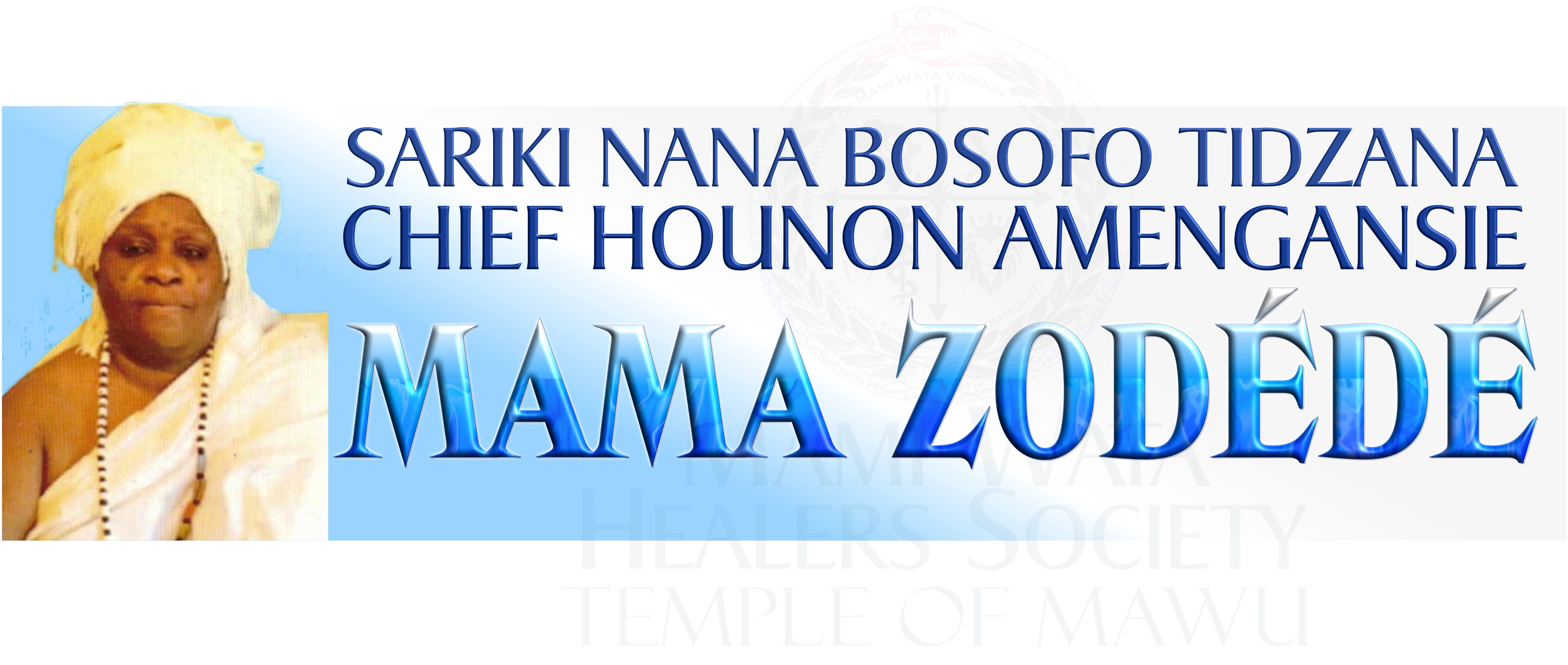
When the title is bestowed to a Hounon priestess or priest in West African Vodoun, it means that the person is actually an initiated chief of a particular Vodou spirit. In West African Vodoun if a person goes by this title, they should be able to tell you what deity they are the “chief” of. In the case of Mama Zogbe and Mama Zodede, they are initiated chiefs of Djihossou (the father of Heviosso/Shango), and of Ejogbe (pronounced "jum-bey"). In West African Vodoun it is considered a serious offense to “self” appoint oneself with this title.
No. Not in an official hierarchal structure as the “Catholic pope.”
Because the Mami Wata & Vodoun are so numerous and ancestrally and ethnically specific and regional, this makes this an impossibile task. However, there can be “Chiefs” of a particular ethnic group, or Egbe of Mami Wata & the Vodou within a specific region, country or Egbe (spirit house). For example, in Togo, the “Chief” of the Ewe is called an Awoamefia, and his role is political as oppose to spiritual.
Customarily, each Egbe (spirit house) can have a Chief/Chieftess of those whom they have initiated and are the grandmother/father to. They might also “self-proclaim” themselves, or may be popular and deemed so based on the power of their particular deity, or their professional experience.
If the priestess/priest has other grand Vodou, that proves more powerful than, or is the "chief" of a particular pantheon of other Vodou of its kind, they are considered “Chief/Chieftess” of that particular Vodou. However, Mami Wata devotees answer to their own Egbe and spiritual mother. They, as all initiates, are only required to extend respect to the Chiefs/Chieftess as is required by all.
To further highlight the complexity of why the Mami Wata Vodoun cannot be ruled by a one-person centralized authority, there are priesthoods centered around a particular deity where they have their own “Chief/Chieftess.” The Amengansie tradition is a case in point. This is also the case with the divinatory system of Afa, and certain secret societies. Yet, during celebrations,they all are equally represented and serve in an equal capacity where they are given equal honor and respect by all including the Spirits.
Additionally, there are some individual priests who might claim to be the “Chief” of ALL of Mami Wata, or the Vodou. However keep in mind that this claim is more political, and is oftentimes made in reference to either his/her own Egbe or ethnic group. A very common assumption since Africans tend to view themselves only within their own ethnic, village or family milieu.
It is also important to note that Africa has a long ancient history of royalty, king and queenships. Generally, these group's “royal reign” often only extend within their own clan groups. This is also the case within the Mami Wata and Vodoun tradition, where families of royal lineages are ethnically and ancestrally specific to each clan groups.
For example, the royal Vodun families and lineages of the Ewe are not subordinate to the royal Vodoun lineages of the Fon, who are a subgroup of the Ewe. As with all royal lineages in Africa, the Fon, Ewe, Mina etc., are merely co-equals and make up numerous subgroups of royal families.
What is also critical in sorting the hype from the facts, is that prior to the Fon’s invasion of the region they later named “Dahomey”, there rest for hundreds of years, the Mami Wata Vodoun royal families of the village chief known as Agrigom, and the Tado Princess, Aligbonu, as well as the Adangme Vodoun clans; all whom were indigenous to Ghana and Togo prior to the Fon’s invasion into the region.
Because of Europe's long business relationship with Dahomey, western historians have been guilty of focusing on the warrior clan of the Fon who invaded and ascended the throne; as being the center of the Vodoun religion. However, this focus does a disservice to Vodoun and Mami Wata’s ancient history by narrowing it to only one specific ethnic/clan group.
In correcting this misperception, it is important for the Diaspora and others to focus on Africa’s theocratic make-up since time immemorial, while placing into perspective the whereabouts of the descendants of the much older royal Vodoun families whose historical existence pre-dates, the Fon. The Fon being forced to pay tributary to the Oyo Empire in Nigeria, actually did so while financing the building of their kingdom by either enslaving or selling these older Mami Wata Vodoun groups into slavery to the New World.
The above is not an indictment against the Fon subgroup. Those were the actions during that period of global empire building around the world. However, with the plethora of independent research conducted by various scholars, it is important to correct the historical record for the benefit of those seeking a more comprehensive understanding of this very dark chapter in African and world history. Read more here: