Translate this page:
You can translate the content of this page by selecting a language in the select box.
Share this link!

Woezoloo! Aenouledoo. This articles hub is where we address Frequently Asked Questions from members and the General Public. Should you have any further questions, we encourage you to review our resources, protocol, services and divination pages. Akpeloo!
The word "Voodoo" utilized today by mainly non-Diaspora (New Age and pagan) converts in Louisana, is considered a prejorative and racist condemnation and mockery of the Vodoun religion as it is respected and practiced in West Africa and in the Diaspora.
It was through the mocked use of the word "VOODOO" where the confusion lies when one is referring to being "VOODOO-ED," when actually they are meaning they have been "HOODOO-ED" or "CONJURED." Vodoun is an ancestral religion in which honor and reverence is given to the African-Diaspora lineage ancestors and community elders, and worship and reverence is bestowed on the divinities.
One cannot "curse" using the Vodoun deities. However, "conjuration" and (to a lessor extent)"hoodoo" are considered malevolent paths in the field of sorcerey and African witchcraft , and are entirely unrelated to the Vodoun religion, no more than "Satanism" and "Christinaity" are related in cosmogony, ritual or practice.
The word "Vodoun" ( other Ewe spellings: Vu, Vudu Vodou ) is derived from the West African Vodoun religions, namely from the Ewe/Fon language groups. In West Africa, the "n" is often pronounced, and is considered the ancient and appropriate appellation of this word. However, in some parts of West AfricaV.O.D.O.U. (voh-doo) is the most common spelling with no emphasis on the "n".
Vodoun is a proper "noun" (always capitalized), denoting the actual Vodoun Religion proper, whereas the use of "vodou" (small "v") is the spelling used to denote the actual Spirits (divinities) that are worshiped.
In the West, the French spelling “Vaudaux" or Vaudou-x," is often found in antiquated anthropology and cultural academic books, but is seldom if ever used in the West African traditions or their writings.
In New World Haitian Diaspora religion, they often use “Vodou” as the common spelling, and refer to their African and local deities using the Creole word “Lwa, which is a corruption of the antiquated Fon word “Loa,” meaning “mystery” or “law.” However, it is important to keep in mind that these two terms are never used in West African Vodoun. The divinities are known simply as “spirits.” This distinction is critical because if one is seeking the services of a Vodoun priest/ess of the West African Vodoun tradition, they would not understand what “Lwa” or “Loa” means when referring to the deities.
In Ewe, the word "vu" (vudu) is actually a metaphorical phrase originally used to describe the nature of the "vodou” Spirits. Its actual meaning "to draw water" is still applied by some to denote the entire process of the cycle of birth, life ,death and rebirth, and all that this encompasses in the life of an initiate (and by default "Human kind").
"To draw water" a long and often tedious process, almost always performed by African women, is analogous to the (initial) sufferings that they endure before they come into their "ashe."
Additionally, the suffix "-oun, -ou, -non" are pervasive throughout Ewe/Fon grammar, and orthographic structure. Below are a few of these words and their meanings. This orthography predates French colonialism, and though the "social" meaning of the word is offered, please note that the spiritual depth of its essential meaning is all pervasive--such is the nature of most African languages:
Vo (cirumflex on all "o"): is the actual word used to describe the original so-called "Voodoo doll." It is derived from the noun "Bochio," which is the actual carved figure used to hold the "Se" "spirit" of a person, became the precursor to the "voodoo doll" when their use and the parctice of Vodoun was outlawed in America. However, they ("Voodoo dolls") are not used in West African-Diaspora Vodoun.
Vodoungbe: Sunday
Vodoungbefond jai: Monday
Vodoun-non: Head Priest ("-non" meaning "father")
Vodoun sin sen: Vodou worshiper
Von: The Earth from which we come Vou: meaning "small" or referring to a young child
Voudide: an enfant
-------------------------------------
FURTHER READING
Hoodoo: The Folk Magic of the African Diaspora
About.com interview with Mama Zogbe.
Hoodoo: A New World Name of An Ancient African & Afro-diaspora Tradition
No. Most of what passes for "legitimate" Vodou in books, hollywood movies and popular culture, is actually the magicobotanical practice of Hoodoo, which is not a religion, and also has its origins in West Africa where it was a fully developed and very powerful tradition borne to specific ethnic lineage's gifted with the spirits to practice it correctly. HOODOO, though not a religion, is the "folk magic" of the common people in West Africa, just as it is in the diaspora today. From socalled "love potions," to taking vegenace upon an enemy, Hoodoo is largely what has survived the religious presecution of the Africans enslaved in the New World. Additionally, due to the laws passed perventing the African from practicing any African based tradition, "Hoodoo" (known as Ggbo in West Africa) was forced to undergo the same superficial transformation as did the Vodou religion (in which they hid their gods behind Catholic Saints). Hoodoo blended with acceptable Native American & European folklore and practice, but the actual methods and power behind it remained completely African. Click here for more historical information on Hoodoo, go to the bottom of this page if you are simply searching for books on the magicbotanical practice of Hoodoo. You may also follow the link below for a recent interview with Mami Wata & Vodoun priestess, *Mama Zogbe*(formerly Mamaissii Vivian) on Hoodoo.
There are "'zombies" only in Hollywood, but not in West African Vodoun. The Hollywood verison of Vodoun cruelly depicts Vodoun healers, priests/ess, and diviniers as little more than "mumbo jumbo" talking frauds, cannibals and witchdoctors, whose only goal is to steal the souls of their unsuspecting victims, rendering them helpless, walking zombies in the end. Additionally, the over embellished and sensationalized Wes Craven movie which he alleges is based upon the book by Wade Davis "Serpent & the Rainbow," did little to educate the public about the true Vodoun religion. Craven's movie instead only served to reinforce the racist and degrading sterotypes created by Hollywood and Christian evangelists of the Vodoun religion. Though there are sorcerers who might attempt such a feat, they are a separate and distinct group from the ANCESTRAL RELIGION of Vodoun. The same as "Satanism" and its practitioners are viewed and considered the antithesis to Christianity by Christians.
There are no "Voodoo dolls" used in West African Vodoun.
The word "fetish" (fetiche) was first introduced by Portuguese merchants who did not possess any other word in their spiritual vernacular or experience, to describe the earthen mound and wooden vodou images enshrined in Dahomey. Today in West Africa, the word "fetish" is used universally and interchangeably with the word "spirit," to describe the vodou.
There are no "Voodoo dolls" used in Dahomean Vodoun. A uniquely AMERICAN HOODOO phenomenon, and Hollywood stereotype, "voodoo dolls" actually have their current origins/usage from pagan Europe. Originally, known as "poppet dolls" (in early Europe), these dolls were used frequently as part of European folk magic and witchcraft as a form of both beneficent and maleficent magic. In Dahomen Vodou carved wooden images, known as "Bochio" were used largely for this and other purposes. However, due to the laws in the U.S and Canada that specifically prohibited Africans from practicing their ancestral religions, the carving of wooden images were also outlawed. In their place, the European "poppet doll" was modified and used in lieu of the wooden carved images employed in Vodoun, to symbolized a person, to PROTECT them from socerey and witchcraft. This is still being done in the magico-botonical art of HOODOO, but not in the ANCESTRAL RELIGION of Vodoun.
Lastly, Vodoun does not offer "how-to advice" to the non-initiated. That is also the domain of the tradition of "HOODOO."
No.
There has never been, nor is there presently, any initiatory rite, or custom (vodou or ancestral) that requires FGM (female genital mutilation) in the Vodoun Religion. This social practice was outlawed in Togo,by a Nov 17, 1998 law making it illegal. Though, it still exist in very small but remote populations in Togo,it is not a common practice amongst the general population, and today is generally frowned upon.
No. Though women are (oftentimes) oppressed in many parts of Africa, the Vodou often becomes the great equalizer. Women are initated into Fa (Ifa), and to all of the Vodous, and at all ranks. In fact, it is Mamaissii Hounons who initiates, set-up shrines, conduct ceremonies, and "open the mouth" of the vodou, etc., and hold the same status and power (usually more) as men.
The notion of "Race" is a political and social construct, created in Western cultures. Race has absolutely no bearing on who is initiated into the Vodoun Religion.
Though Hollywood & popular culture have left the univeral impression that African religions are secret, blood-letting "cults." In truth, all African Traditional "Religions" are actually inseperable from the way of life for the African. They are not seperate, mysterious nor dichotomous (dualistic)paths/vocations as are common in most Western-based religions.
To understand African "Religions" in their proper context, it is necessary to understand the culture in which it incorporates itself.
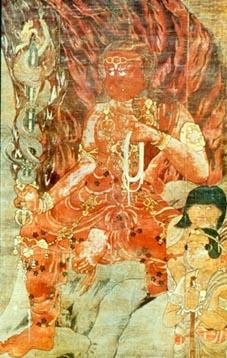
Black Buddhist Deity Fudo Myo'o
Most African Traditional Religions can co-exist with many religious systems, as is evident in West Africa today, where one will find a Christian leaving church to make sacrifices to their family deities and Ancestors, or a Muslim offering libation to theirs.
Spiritual disciplines designed to relieve personal and universal suffering, such as in following the Eightfold Path practiced by many sects in Buddhism, is not a contradiction to either the Vodoun nor Mami Wata tradition.
These virtues are also no more unique to Buddhism, as Morality is to Christianity. These tenents exists within ATRs (African Traditional Religions) as well, and may even have their early genesis in Africa.
Conversely, in spite of the media's overemphasis on the magical aspects of Vodoun, there are levels, both mystical and practical, in which one can see the parallelism between Buddhism's historical development, and its ancient African origins.
Additionally, though certain Buddhist sects tend to downplay its early significance, there were a variety of magical and ritual arts, utilized and incorporated into Buddhism's early practice which is very similar to Vodoun.
For example, the use of magical incantations to call upon deities known as the Myo-o for both personal protection, and community defense against witchcraft and sorcery was widely practiced by many advanced Buddhists priests (monks).
These deities would indeed manifest and come to their defense, many armed with a variety of unique weapons.
This Myo-o was associated with the Kurai Kotori Clan, known as Fudo Myo-o, meaning the Unmoving Illuminating King.
What is important and interesting to note, is that few practicing Buddhists today even know that this Unmoving Illuminating King deity (Fudo Myo-o), was an African.
He was known in China as Fire or the immovable fire. What is even more interesting, is that one of Fudo Myo-o's particular implement was the thunderbolt, which he holds in his right hand.
Similarly, in Vodoun, the Thunderbolt is also the implement of Heviosso, our Thunder god, and is considered one of the most powerful gods in the West African Vodoun pantheon.
Fudo Myo-o in the above photo also holds a staff implement coiled by a serpent. Of course, many Vodoun practitioners will quickly recognized this symbol as the Rainbow Serpent Spirit Da (Dan), the deity who encompasses many powerful attributes of health, wealth, movement (rhythm) creativity and wisdom, not to mention representing the collective embodiment of our African ancestors.
Indeed, it would greatly benefit African-Americans, and those interested in unearthing the hidden past of Africa's early religious influence on the major religions, to learn more about, to embrace and not shun nor forget their own indigenous roots, as they seek out a suitable spiritual path.
In doing so, they will find that they greatly compliment rather than contradict many of the so-called modern spiritual tenents such as those found within contemporary Buddhism.
Finally, below are links for further research and study for AA's and others interested in Buddishism from an African American perspective. We recommend to type them into your browser to check availability of the sites.
http://www.proudblackbuddhist.org/Buddhist_The Black Buddhist Deity Fudo Myo'o
http://www.butterflyjournal.com/15_choyin_rangdrol.htm Article: Choyin Rangdrol Racism in Buddism
http://home.earthlink.net/~srama/ Essentials of Buddhism
http://www.proudblackbuddhist.org/ African & African-American Nichiren Shoshu Buddhist Web Site
No. In West African Vodoun cosmology the concept of soul transmigration is foreign. This concept goes against the entire system of ancestral reincarnation and deity lineage through their own blood/kin/spiritual progeny. It is also known by West African & Diaspora Vodoun adepts that one remains the same gender, race and species throughout the entire duration of their soul existence.
Absolutely not. The world and law of the spirits and ancestor\'s is different from that of humans. The world have been conditioned to view \"race\" as the defining feature of a human, whereas the spirit sees \"the character and condition of the soul,\" as the primary criteria. That is all that matters.
Listed below are instructions for Zelle payments, as well as payment links to pay via Cash App or PayPal. Please note, if you are going to pay or donate on behalf of someone else, please indicate their name and the purpose of payment in the Memo or Notes Sections. Akpelooo!