Translate this page:
You can translate the content of this page by selecting a language in the select box.
Share this link!

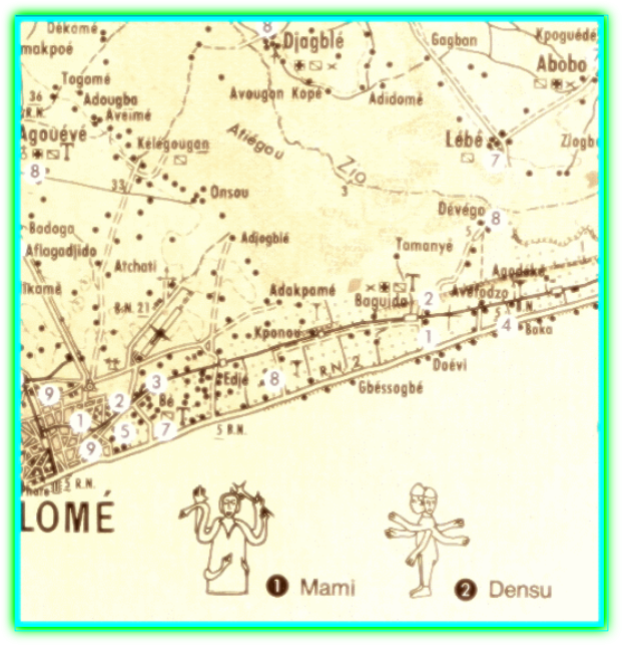
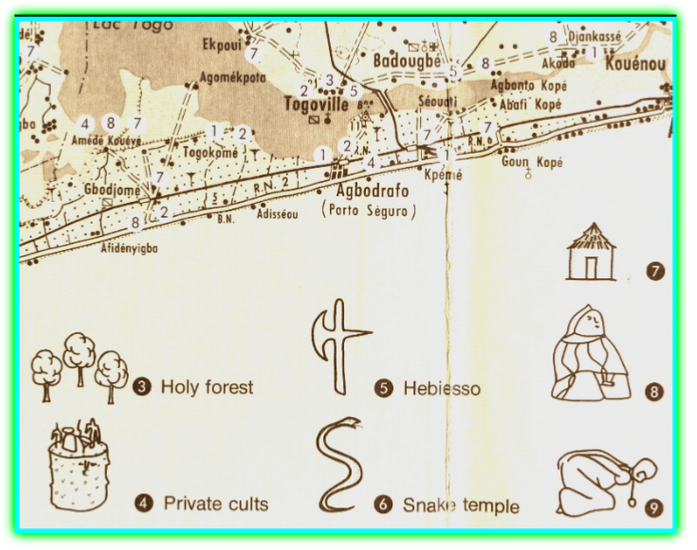
Contrary to popular belief, with the exception of some Houses in Brasil, West African & Diaspora Mami Wata Vodoun is not similar to the syncretic forms of Vodoun practiced in either Haiti or anywhere else in the New World. To better understand West African & Diaspora Mami Wata Vodoun, one must study the early history and development of the growing Oyo Empire of Nigeria, and the many ethnic groups that were directly responsible for both its technological and spiritual development. Specifically, the break and early migration of the Ewe/Fon from this region around the early (est.) 1300's. The Ewe also trace their spiritual ancestral roots to being one of the children of Oduduwa, and have been worshipping the Orisha for centuries. Though after their departure from Oyo, and oftentimes warring enemies (with their cousins the (now collective) Yoruba), there were moments of peace in which they were able to form some of the most powerful priesthoods in this region, that too became incorporated into the Oyo (Oba) State.
Additionally, most anthropologists have wrongfully assumed and documented that all of the gods honored in West African & Diaspora Mami Wata Vodoun are a direct result of borrowing from the Yoruba, in which they transported them to Ketou, and (later) Notsie (northeast Dahomey) during that break. In truth, there was an equal exchange between both cultures of both gods and traditional forms of worship.
For example, the Yoruba divinity "Babaluaiye," is a borrowed Vodoun god from the Ewe/Fon known locally as "Sakpata/Aholou". Additionally, the gods "Nanan" "Olokun" [Ewe masculine Mami Wata divinity], "Osumare" [the Ewe/Fon pantheon of Da], as are several others not as popularly known are from Dahomey. The priesthood of Shango, is known as Hevieosso , and is considered the highest god of the sky by the Ewe, has its ancient origins in Tsevie of ancient Dahomey. Thus, unlike the borrowed Dahomean Nanan and Babaluaiye et.al, in the Ifa'Orisha pantheon of the Yoruba, today, with the exception of the shared "Gu (Ogun)" none of the major Gods in the local Dahomean panethon are outside dieties.
Another misconception often assumed by most, is that the West African & Diaspora Mami Wata Vodoun gods are of lessor "power" or level of development than those of the Yoruba. This is another myth that needs no further explanation other than to state that there is no quantitative difference between either the gods of Dahomey or the Orishas. Only those who know and work with the Vodou and understand the nature of how the gods operate know this. Below are some of the general characteristics commonly shared between the Vodou gods of Dahomean and the Orishas in the Yoruba Ifa'Orisha tradition.
NOTE: As a rule, it is not advisable to make comparisons or assume that the corresponding divinities of Vodoun and the Orishas are the same. They are not. However, what is offered, is a loose ccorrelation based upon the general aspects of NATURE in which each is characterized to have dominion over. Their individual uniqueness remains specific for each.
Dahomean Vodou
Mawu
Afa
Legba
Da
Hoelousou Da
Egu/Gu
Heviosso
*Mami Wata
Avedji Da
Sakpata
Age
Dan Sissinnon
Yoruba
Olodumare
Orunmila
Eshu
Obatala
Oduduwa
Ogun
Shango
Oshun, Olokun, Yemoja
Oya
Babaluaiye
Osanyin
Aganu
General Function
High God
Voice of God
Messenger for Gods*
Owner of White Cloth
Consort of Da/Obatala
God of Iron and War
Thunder God
Water Gods
Wind God
Earth God/Healing/Disease
God of Herbs/Hunter
Fire Spirit
Papa Kunde
Sacra Bode
Kadzanka
Gede
Nana Ablewa
Banguele Ketetse
Allah
Sunia Compo
Nana Wango
Hohovi
Banguele
Aganu
Nuseuwex (Loko)
Adjakpa
Toxhosou
African Tradition and Culture: Media